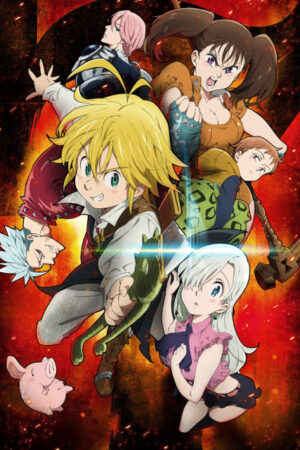
Official That Time I Got Reincarnated as a Slime Season 2 promotional poster. © Fuse / Kodansha / Tensura Production Committee
Kagex rating: 8.7 / 10
Season: Season 2 · 24 episodes · split cour
Aired: January 12–March 30, 2021 and July 6–September 21, 2021 · Studio: 8bit
That Time I Got Reincarnated as a Slime Season 2 takes the comfortable nation-building fantasy of Season 1 and asks the question it had been carefully avoiding: what happens when Rimuru’s peaceful monster country becomes valuable enough for powerful people to fear, exploit, or destroy?
The answer is the franchise’s strongest television season so far. Tempest is no longer a cute village waiting for its next festival. It is a state with trade routes, allies, enemies, civilians, and consequences. Rimuru is no longer allowed to solve every problem by being friendly and overwhelmingly capable. He has to decide what kind of ruler he will become when kindness fails.
Season 2 is darker, more political, and occasionally far slower than its best action scenes suggest. It also delivers the emotional and strategic payoff that Season 1 spent 24 episodes earning. If you already care about Tempest, this is where Tensura stops being merely cozy and becomes genuinely gripping.
Hook
Season 1 made building a nation look fun. Name a few monsters, recruit talented craftspeople, defeat a regional threat, and celebrate over good food. Season 2 keeps that warmth, then shows the bill. Trade creates jealousy. Recognition creates scrutiny. Rimuru’s strength attracts opponents who know attacking him directly would be stupid, so they target laws, alliances, public opinion, and the people he cannot protect all at once.
The season also understands its main appeal. Rimuru remains a wildly overpowered slime surrounded by an increasingly absurd collection of loyal monsters. This is still a power fantasy. The difference is that Season 2 gives the power an emotional trigger and a political cost. Watching Rimuru win is satisfying because the story first makes him confront what losing means.
Quick Information
- Anime: That Time I Got Reincarnated as a Slime
- Japanese title: Tensei Shitara Slime Datta Ken
- Season: Season 2
- Episodes: 24
- Format: Split cour
- Part 1 air dates: January 12–March 30, 2021
- Part 2 air dates: July 6–September 21, 2021
- Studio: 8bit
- Genres: Fantasy, isekai, adventure, action, comedy, nation-building
- Source: Light novel by Fuse
- Opening themes: “Storyteller” by TRUE and “Like Flames” by MindaRyn
- Ending themes: “STORYSEEKER” by STEREO DIVE FOUNDATION and “Reincarnate” by Takuma Terashima
- Where to watch legally: Crunchyroll, subject to regional availability
- Kagex score: 8.7 / 10
Official That Time I Got Reincarnated as a Slime Season 2 promotional banner. © Fuse / Kodansha / Tensura Production Committee
Should You Watch Season 2?
Yes, especially if Season 1 made you care about Tempest as a place rather than only Rimuru as a protagonist. Season 2 is the payoff season. It turns old alliances, named citizens, trade plans, and casual promises into pressure points. The first season built the board; this one finally lets hostile players move across it.
You do need to watch Season 1 first. This is not a clean jumping-on point. The emotional force depends on knowing Rimuru’s people, while the political conflict assumes you understand why a monster nation has changed the balance around the Great Forest of Jura. Start at the Tensura anime hub if you need the proper order.
Who will love it? Viewers who enjoy kingdom-building, faction politics, revenge delivered with overwhelming force, ensemble casts, and long setups that lead to decisive payoffs. Fans who thought Season 1 was too safe will probably find the first cour much stronger.
Bottom line: Season 2 is essential Tensura. It has the franchise’s most painful setback, one of its coldest displays of power, a major evolution for Rimuru, and a climax that reshapes the demon hierarchy. Begin with the Season 2 Episode 1 review if you want a closer look at how the new chapter starts.
Spoiler Warning
Major spoilers for That Time I Got Reincarnated as a Slime Season 2 follow. The story overview and analysis discuss the invasion of Tempest, character deaths, Rimuru’s Harvest Festival, Walpurgis, and the season’s ending. Skip to the Final Verdict for a lighter recommendation.
Season Story Overview
Season 2 is structured around consequences. Rimuru’s successful diplomacy creates new opportunities, but every connection makes Tempest more visible. The season moves from trade and routine administration into catastrophe, resurrection, retaliation, and finally a confrontation among Demon Lords. It is a larger story than Season 1, but its emotional center stays simple: Rimuru built a home, and someone chose to attack it.
Busy Tempest and the Eurazania connection
The opening stretch catches up with the daily work of running Tempest. Delegations move between nations, students need proper farewells, and relationships established earlier become formal agreements. Rimuru’s alliance with the Beast Kingdom of Eurazania brings Demon Lord Karion into sharper focus. The exchange is funny and useful, particularly when each side sends representatives whose personalities are not exactly designed for quiet diplomacy.
This material can feel like housekeeping, but it establishes what is at risk. Tempest has products people want, roads worth using, military credibility, and allies beyond the forest. Rimuru believes mutual benefit will make peace durable. He is not completely wrong. He is simply underestimating how quickly economic success can create political enemies.
Falmuth invades and Tempest breaks
The Kingdom of Falmuth sees Tempest’s trade route as a direct threat to its prosperity. Rather than compete honestly, its leadership joins a wider scheme that frames monsters as a danger and gives human soldiers permission to invade. A barrier weakens Tempest’s residents, while another confrontation keeps Rimuru away when his people need him most.
Shion dies protecting others, and the image of her body waiting among Tempest’s dead changes the season. Rimuru’s usual composure disappears. His first response is not a cool strategic speech. It is denial, guilt, and the crushing realization that his rules may have left his people unable to answer lethal hatred with enough force.
Official That Time I Got Reincarnated as a Slime Season 2 key visual. © Fuse / Kodansha / Tensura Production Committee
Megiddo and the Harvest Festival
A possible path to resurrection gives Rimuru hope, but it demands an enormous number of human souls. The Falmuth army has conveniently gathered outside Tempest, still expecting victory. Rimuru decides that the force responsible for the massacre will become the price of reversing it.
Megiddo is the season’s defining sequence. Rimuru uses focused sunlight and water droplets to cut through the army with terrifying efficiency. There is little struggle and no attempt to make the soldiers look heroic. The scene works because it refuses the visual language of a competitive fight. This is judgment from a being operating on another level.
The collected souls trigger Rimuru’s Harvest Festival and evolution into a True Demon Lord. Great Sage pushes toward its own evolution, eventually becoming Raphael, while Tempest enters a strange sleep connected to Rimuru’s gift. The resurrection succeeds. Shion and the other victims return, preserving the hopeful core of the series without erasing the terror that led there.
Walpurgis, Clayman, and the Octagram
Part 2 widens the conflict from Falmuth to the Demon Lords. Clayman has manipulated events from behind the scenes, used Mjurran as a disposable tool, and targeted Eurazania. Rimuru prepares for Walpurgis, the gathering where Demon Lords debate, posture, and settle matters with the kind of power that makes national armies look small.
Walpurgis makes the wait worthwhile. Milim Nava appears to be under Clayman’s control, Karion’s fate becomes part of the deception, and Rimuru enters a room containing personalities such as Guy Crimson and Ramiris. The scene is part political theater, part boss arena, and part introduction to a much stranger upper tier of the world.
His defeat leads to the reorganization of the remaining Demon Lords as the Octagram. Rimuru has not merely survived a conspiracy. He has entered the highest political circle in the setting and forced it to acknowledge him.
Ramiris, the labyrinth, and a human-facing king
The season closes by placing pieces for the next political stage. Ramiris becomes tied more closely to Tempest, with the future labyrinth offering a clever match for her abilities and personality. It is classic Tensura planning: turn a potentially troublesome supernatural figure into a friend, then give that friend a job that also strengthens the city.
Youm’s role is more practical. Rimuru cannot personally govern every human territory affected by Falmuth’s collapse, and a monster ruler directly seizing a human kingdom would confirm every hostile rumor. Youm offers a human-facing alternative with credibility among ordinary people. Diablo handles the darker diplomatic pressure around King Edmaris and Razen.
This setup points toward a conflict that cannot be solved only through overwhelming magic. Human institutions, religious authority, and the unfinished misunderstanding with Hinata Sakaguchi remain important. Season 2 ends with victory, but not with universal acceptance.
Story Analysis
Season 2 succeeds because its darkest turn grows directly from the first season’s optimism. Tempest is attacked for being prosperous, strategically located, and populated by monsters whom human leaders can dehumanize. The disaster is not random punishment inserted to make the sequel edgy. It is the logical backlash to Rimuru changing the regional order faster than established powers can tolerate.
The central theme is the limit of idealism. Rimuru’s rule against harming humans came from a sensible desire to avoid escalation. In practice, it created hesitation during an attack by people who had no equivalent restraint. The lesson is not that mercy is foolish. It is that a ruler cannot treat a personal moral preference as a complete defense policy.
That gives Rimuru’s evolution meaning beyond a new skill list. Becoming a True Demon Lord is a political and moral declaration. He accepts that protecting Tempest may require lethal force, deception, and participation in a world of frightening powers. He does not abandon kindness. He stops assuming kindness alone will control the behavior of his enemies.
The resurrection remains a reasonable point of debate. Bringing everyone back protects Tensura’s hopeful identity and rewards Rimuru’s desperate choice. It also reduces the permanence of death. The season handles this better than a casual reset because the solution requires mass killing and irreversible evolution, but future danger inevitably feels less absolute once resurrection has worked.
Even with that caveat, Season 2 has a strong complete shape: prosperity creates exposure, exposure leads to catastrophe, catastrophe forces transformation, and transformation demands recognition. It is not simply “Rimuru gets stronger.” It is “Tempest becomes impossible to dismiss.”
Official That Time I Got Reincarnated as a Slime Season 2 promotional artwork. © Fuse / Kodansha / Tensura Production Committee
Character Analysis
Rimuru Tempest
Season 2 is Rimuru’s best character material. His power has always been obvious; his readiness to carry responsibility was less certain. The invasion destroys the comforting belief that good intentions and personal strength guarantee safety. His grief over Shion and the other victims feels like a leader confronting his own failure, not simply a protagonist getting angry enough to unlock a form.
Shion, Benimaru, Shuna, Souei, and Tempest’s core
Shion’s death is the emotional center, but her return also shows the season’s tonal balancing act. The story can make her absence devastating and later bring back comedy without pretending nothing happened. Her loyalty becomes even more intense, while her evolution gives her an appropriately dangerous edge.
Mjurran and Youm
Mjurran gives the invasion a personal complication. She participates in the barrier under coercion, knowing Clayman treats her life as leverage. Her bond with Youm makes forgiveness emotionally plausible without making her actions harmless. Rimuru’s response is calculated mercy: free her from Clayman, preserve an ally, and use the situation to support a larger political story.
Diablo, Veldora, and Milim
Veldora Tempest finally returning gives Rimuru a friend, strategic deterrent, and walking natural disaster in one package. The reunion works because the relationship began before Tempest existed. Milim’s role at Walpurgis is built around misdirection, but her loyalty remains consistent beneath the performance.
Clayman and the Demon Lords
Guy Crimson, Ramiris, Karion, and the rest of the gathering make the Demon Lord title feel less like one uniform class. Some command through fear, some through personality, and some barely respect the ceremony. That variety makes the Octagram a more interesting promise than a simple villain council.
World Building
Season 2 expands Tensura through institutions rather than travel. Falmuth’s dependence on trade revenue explains why Tempest is a threat without requiring ancient prophecy. The Western Holy Church introduces a moral and political framework in which monsters can be condemned before any individual action is judged. Eurazania shows another model of Demon Lord rule, while Walpurgis reveals how the strongest figures manage status among themselves.
Tempest’s response to victory is equally important. It does not simply annex everything in sight. Rimuru needs trade, legitimacy, human partners, intelligence, and controlled narratives. The plan involving Youm proves that the series understands political power is partly about who people are prepared to recognize.
Animation Review
Studio 8bit gives Season 2 a functional, colorful baseline and saves its strongest direction for the moments that define the season. Megiddo is the obvious peak. The clean beams, distant framing, sudden impacts, and Rimuru’s emotional stillness make it more memorable than a busier fight would have been.
Not every battle reaches that level. Army clashes can look efficient rather than spectacular, and several meeting-heavy episodes rely on standard coverage. Backgrounds and compositing remain consistent, but this is not a season of nonstop showcase cuts. The production is best when atmosphere, timing, and a single dominant idea carry the scene.
Music and Voice Acting
TRUE’s “Storyteller” fits the first cour’s mix of forward motion and looming change. MindaRyn’s “Like Flames” gives Part 2 a more urgent identity, matching a Rimuru who has crossed into a new level of power. “STORYSEEKER” by STEREO DIVE FOUNDATION carries a sleek, searching mood, while Takuma Terashima’s “Reincarnate” closes the second cour with a fitting sense of renewal.
Voice acting remains one of Tensura’s quiet strengths. Rimuru has to move between friendly leader, devastated survivor, calculating ruler, and comedic straight man without sounding fragmented. Shion’s energy, Diablo’s refined menace, Veldora’s enormous enthusiasm, and Clayman’s increasingly desperate arrogance all land. The Walpurgis ensemble sounds like a room full of egos with centuries of confidence behind them.
Best Moments
Rimuru finding Tempest’s dead. The season’s emotional breaking point works because the show allows silence, guilt, and disbelief to replace its usual easy confidence.
Megiddo. A terrifyingly simple use of Rimuru’s abilities and one of the strongest demonstrations of overwhelming power in modern isekai.
The Harvest Festival and resurrection. Relief, transformation, and the payoff to Rimuru’s most consequential decision arrive together.
Diablo answering the summons. Tempest gains a servant who feels more dangerous than many rulers, and the entire power scale shifts.
Veldora’s return. A long-promised reunion that brings back the friendship at the heart of Rimuru’s new life.
Walpurgis exposing Clayman. Political lies collapse, Milim’s performance pays off, and Rimuru claims his place among the Demon Lords.
The Octagram takes shape. The season closes by turning a victory into a new world order rather than pretending the conflict existed in isolation.
Pros and Cons
Pros
- The Falmuth invasion gives Tempest’s nation-building real consequences.
- Rimuru receives his strongest emotional and leadership development.
- Megiddo and Walpurgis deliver major, memorable payoffs.
- The ensemble matters politically and emotionally, not only as backup fighters.
- World building connects trade, religion, prejudice, diplomacy, and power.
- The season preserves Tensura’s hopeful identity while allowing genuine darkness.
Cons
- Part 2 contains too many meetings that repeat already clear plans.
- The successful resurrection reduces some long-term fear around death.
- Clayman is more satisfying to hate than impressive to fight.
- Animation quality is steady but concentrated around a few standout sequences.
- Viewers seeking constant action may find the political preparation slow.
Final Verdict
That Time I Got Reincarnated as a Slime Season 2 is where the franchise earns the loyalty Season 1 asked for. It takes the cozy pleasure of watching Tempest grow and turns that attachment into tension. The invasion hurts because the city felt safe. Rimuru’s retaliation satisfies because his kindness had limits. Walpurgis excites because his new status changes the world rather than merely updating a stat screen.
The season is not perfectly paced. Part 2 sometimes explains strategy until momentum evaporates, and the production saves its visual ambition for selected peaks. Those weaknesses matter, but they do not outweigh the emotional force of the Falmuth arc, the precision of Megiddo, or the political payoff of Clayman’s fall.
This is still a generous power fantasy. Rimuru’s side gains extraordinary abilities, lost friends return, and most hostile plans eventually collapse under better preparation. What makes it work is the reason behind the power. Tempest is not a trophy. It is a community, and Season 2 makes defending it feel personal.
- Story: 8.8 / 10
- Characters: 8.7 / 10
- Animation: 8.2 / 10
- Music: 8.4 / 10
- Enjoyment: 8.9 / 10
- Overall: 8.7 / 10
Recommendation: watch it. Season 2 is essential for anyone continuing Tensura and a strong example of how an overpowered isekai can create stakes through responsibility instead of pretending the hero might lose every duel. It is darker without becoming cynical, political without losing its warmth, and rewarding enough to justify the slower meetings.
What Comes Next
Season 3 follows a Tempest that is stronger and more visible than ever. Rimuru’s Demon Lord status does not automatically solve his relationship with human institutions. The misunderstanding involving Hinata and the influence of the Western Holy Church remain major pressure points.
Expect more diplomacy, public celebration, economic planning, and conflict shaped by what different factions believe about monsters. The next season is less about repeating Falmuth’s tragedy and more about proving whether Tempest can turn overwhelming military security into lasting legitimacy. That is all the setup you need without spoiling unaired or later material.
FAQ
Is That Time I Got Reincarnated as a Slime Season 2 worth watching?
Yes. It is one of the franchise’s strongest seasons, combining a painful attack on Tempest, major growth for Rimuru, and the political payoff of Walpurgis. Season 1 fans should consider it essential.
How many episodes are in Tensura Season 2?
Season 2 has 24 episodes. It aired as a split cour: Part 1 ran from January 12 to March 30, 2021, and Part 2 ran from July 6 to September 21, 2021.
Do I need to watch Season 1 first?
Absolutely. Season 2 depends on relationships, alliances, and nation-building established in the first season. The invasion has far less impact if Tempest and its residents are unfamiliar.
Is Season 2 darker than Season 1?
Yes. It includes civilian deaths, grief, war, and Rimuru making a lethal decision on a huge scale. The series remains hopeful and comedic overall, but this season tests that optimism more seriously.
Why does Season 2 have so many meetings?
The story is coordinating multiple nations, armies, and political deceptions before Walpurgis. Most meetings contain useful information, but the adaptation repeats some plans too often. Viewers who enjoy strategy will tolerate the stretch better than viewers watching only for fights.
What are the Season 2 opening and ending songs?
The opening themes are “Storyteller” by TRUE and “Like Flames” by MindaRyn. The ending themes are “STORYSEEKER” by STEREO DIVE FOUNDATION and “Reincarnate” by Takuma Terashima.
Where can I watch Tensura Season 2 legally?
Crunchyroll carries the series in many regions. Streaming rights and available language options can vary, so check the current catalog where you live.
Does Season 2 end on a cliffhanger?
It resolves the main Clayman and Walpurgis conflict, so the season has a proper climax. It also establishes new political problems and Tempest projects that lead naturally into Season 3.
Should I watch Season 3 after this?
Yes, if the politics and nation-building are as important to you as the action. Season 3 continues the church conflict and explores what Rimuru’s new status means in practice. Read the Tensura Season 3 review next.
Keep exploring
- That Time I Got Reincarnated as a Slime anime hub
- Tensura overall review
- Tensura Season 1 review
- Tensura Season 3 review
- Season 2 Episode 1 review
- Browse Tensura seasons and episodes
Your turn
Was Megiddo the moment Season 2 became peak Tensura for you, or did Walpurgis take the top spot? Did the resurrection preserve the show’s heart or soften the consequences too much? What score would you give the season?