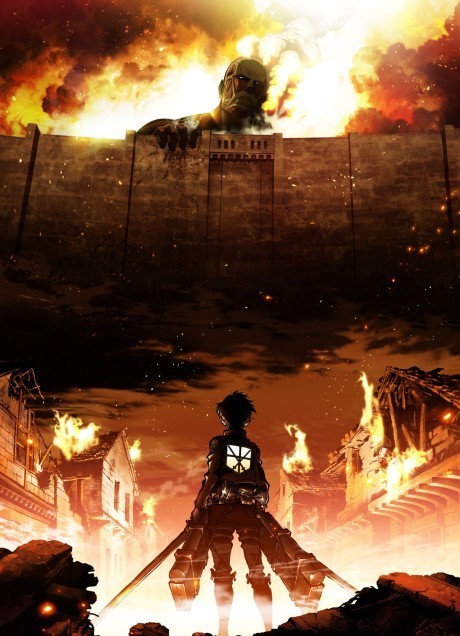
Some pilots ease you into their world. Attack on Titan Season 1 Episode 1 kicks the wall down — literally — in the first ten minutes and never lets you feel safe again. This is the day Eren Yeager’s argument with his mother about joining the Scout Regiment stops being a hypothetical, the day a Titan taller than the wall itself ends a century of false peace, and the day Eren loses everything the episode spent its first act showing you he loved. Stay for the wall. Stay for the collapse. Stay if you can handle watching a family get torn apart in real time.
Hook
For a hundred years, humanity has lived inside three concentric walls — Maria, Rose, and Sina — hiding from man-eating Titans that erased civilization outside them. That peace has calcified into complacency: soldiers drink instead of train, townsfolk mock anyone who wants to see the outside world, and Eren Yeager is the kind of kid who gets laughed at for saying he wants to join the Scout Regiment and actually leave the walls.
Then a Titan taller than the outer wall itself appears where no Titan should be able to reach, and every argument about safety, curiosity, and cowardice becomes irrelevant in about ninety seconds. Episode 1 is not interested in easing you into its stakes. It shows you an ordinary, slightly frustrating family morning, and then it shows you exactly how fragile that morning was.
What makes this premiere land as hard as it does is not the scale of the disaster — it is the specificity of what gets taken. This is not a wide-shot montage of a city falling. It is one house, one mother, one son who is fast enough to run and not fast enough to save her. The question this page answers: does Episode 1 hold up as a horror-tragedy on its own terms, separate from everything the franchise becomes later?
Quick Information
- Anime: Attack on Titan (Shingeki no Kyojin)
- Season / Episode: Season 1, Episode 1
- Japanese episode title: 二千年後の君へ ―シガンシナ陥落①― (“To You, in 2000 Years: The Fall of Shiganshina, Part 1”)
- Runtime: about 24 minutes
- Studio: Wit Studio (with Production I.G assistance)
- Genres: Action, Dark Fantasy, Drama, Military, Horror
- Original air date: April 7, 2013
- Opening / ending themes: “Guren no Yumiya” by Linked Horizon (OP) · “Utsukushiki Zankoku na Sekai” by Yoko Hikasa (ED)
- Kagex score: 9.4 / 10
- Where to watch legally: Crunchyroll (availability can vary by region)
Should You Watch It?
Yes, but go in prepared — this is not a gentle premiere. Episode 1 spends its first act on a fairly ordinary family argument about ambition and safety, then detonates that ordinariness completely. You do not need any prior knowledge of the walls, the Titans, or the world’s history; the episode teaches all of it through lived experience rather than exposition dumps.
Is it worth watching? Absolutely, and it is one of the strongest cold opens in modern anime. The Colossal Titan reveal and the house collapse are staged to be genuinely disturbing, not just spectacular, and that distinction is why the episode is still discussed over a decade later.
Is it slow? No. The Titan breach happens well before the halfway mark, and the back half is a sustained, escalating chase. If anything, the episode has almost no downtime once the wall falls.
Is it beginner friendly? Yes, in the sense that it requires no homework. It is emotionally brutal, though — this is not a light watch, and the ending is designed to disturb you rather than comfort you.
Who will enjoy it? Fans of dark fantasy, horror-adjacent stakes, and stories willing to hurt their characters for real instead of as a bluff. If you want a series that treats danger as actually dangerous from minute one, this delivers immediately.
Who might bounce? Viewers sensitive to graphic violence or child-in-peril imagery should know this episode does not soften its punches. It is intense by design.
Bottom line: watch it, and understand what you are signing up for. Episode 1 is the moment Attack on Titan announces it will not protect you or its characters from consequences.
Spoiler Warning
Spoilers for Season 1 Episode 1 follow. Stop above if you want a clean first watch. This page discusses only what this episode itself reveals — no later-season lore about the title’s deeper meaning.
Story Recap
Ordinary Life (an argument about the outside world)
Shiganshina, a district at the very edge of Wall Maria, is as close to the frontier as humanity gets — and it is still boring, restrictive, and safe by design. Eren Yeager wants to join the Scout Regiment and see the world outside the walls; his mother Carla wants him to want anything else. His adoptive sister Mikasa Ackerman watches the argument with quiet concern, already positioned as Eren’s protector even in a scene about nothing more dramatic than a dinner-table disagreement.
Eren’s father, Grisha, is largely absent but makes a quiet promise before leaving on a trip: he will show Eren the secrets in the basement of their house someday. It is a small, easily missed detail buried under a much louder family argument — and this episode does not ask you to weigh it yet.
Unexpected Incident (something taller than the wall)
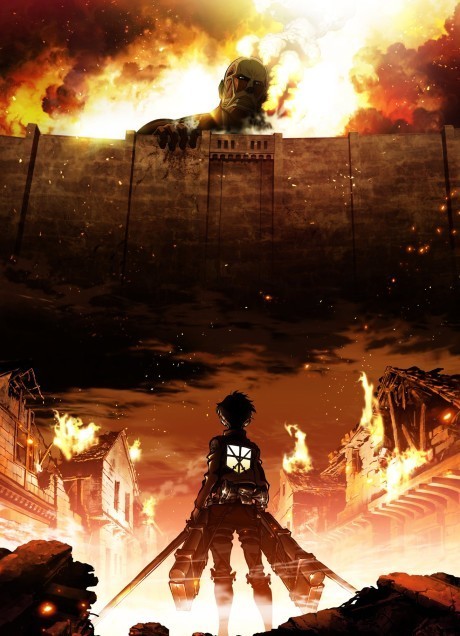
The peace of Shiganshina ends with a single, wordless shot: a Titan taller than Wall Maria itself, standing where no Titan should physically be able to stand. This is the Colossal Titan, and its mere presence — before it does anything else — is enough to break a hundred years of assumed safety. The wall was supposed to be the one guarantee. It is not.
New World (the gate comes down)
The Colossal Titan’s attack breaches the outer gate, and ordinary Titans — smaller, but still monstrous and still hungry — pour into Shiganshina through the opening. What was a controlled, walled civilization becomes a warzone in minutes. Soldiers scramble. Civilians run. The show does not give you a montage of heroics; it gives you panic, because panic is what actually happens when a century of assumed safety turns out to be false.
First Discovery (the house comes down)
Eren races home into the chaos and finds his own house partially collapsed, with Carla trapped and pinned beneath the wreckage — her legs crushed, unable to move even as the danger closes in. This is not a wide-scale disaster shot. It is a single room, a single mother, and a son realizing in real time that willpower is not enough to move rubble.
Important Encounter (the Smiling Titan)
A Titan — grinning, almost gleeful in its approach — closes in on the trapped family. Hannes, a family friend and Garrison soldier, arrives and tries to help, but freezes against the scale of what he is facing. In the seconds that matter most, he chooses to grab Eren and Mikasa and run rather than risk a fight he cannot win. Carla, left behind, begs them to survive as the Titan reaches her. The episode does not look away from what happens next, and it does not let Eren look away either — the entire encounter is staged so that he, and the audience, watch it happen in full.
Story Analysis
Episode 1’s structure is a controlled demolition of its own opening act. Everything established in the first several minutes — the argument about safety, the promise about the basement, the mundane friction of a family that loves each other imperfectly — exists specifically so its destruction has weight. This is not a series that believes in wasted setup.
Pacing is deliberately front-loaded with normalcy and then relentless once the wall breaks. That imbalance is the point: real disasters do not politely wait for your emotional preparation, and the episode wants you to feel the whiplash of a good morning becoming the worst day of Eren’s life with almost no transition.
Horror is the operative genre here as much as action. The Colossal Titan’s reveal withholds explanation on purpose — you do not know what it is, why it is there, or what it wants, and that uncertainty is scarier than a clear villain monologue would be. The Smiling Titan doubles down on this: its expression reads as pleasure, not hunger-as-instinct, which makes it feel less like an animal and more like something actively enjoying the encounter.
Emotional impact is built on helplessness, not heroism. Hannes is not a coward for running — the episode frames his choice as a horrifyingly reasonable response to an unwinnable fight — and that refusal to give the audience a clean hero moment is what makes the loss feel earned rather than manipulative.
Theme announces itself immediately: safety is a story people tell themselves, and walls are only as strong as everyone’s willingness to believe in them. Eren’s wish to see beyond the walls, mocked at the start of the episode, is answered in the cruelest possible way — the outside world came to him instead.
Character Analysis
Eren Yeager — ambition meeting consequence
Eren opens the episode as a frustrated teenager who wants more than his walled world offers — a want the show treats as legitimate rather than naive. By the episode’s end, that want has been answered with trauma instead of adventure. His grief is not stoic; it is loud, physical, and unresolved, which sets up a character who will need to build his resolve from wreckage rather than idealism.
Mikasa Ackerman — protection as instinct
Mikasa says relatively little in Episode 1, but her positioning — always near Eren, always alert — establishes her role before the plot forces her into it directly. She is not introduced through a speech about loyalty; she is introduced through proximity and vigilance, which the disaster then justifies completely.
Carla Yeager and Hannes — the cost and the guilt
Carla’s final scene is the episode’s emotional core: trapped, aware of what is coming, and using her last moments to beg for her children’s survival rather than her own. Hannes’s failure to save her is not played as villainy — it is played as a devastatingly human limit, and the show clearly intends for the guilt of that choice to follow him.
World Building
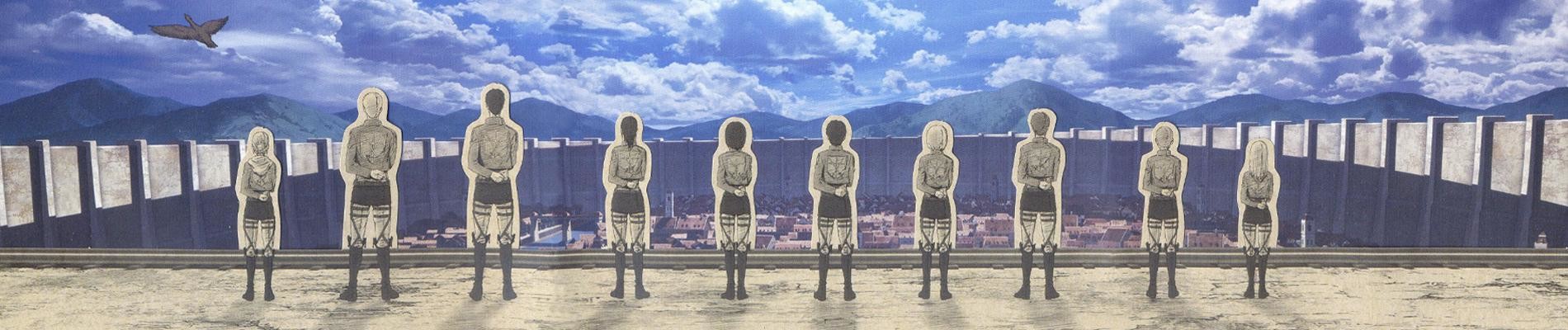
Episode 1 establishes the series’ foundational geography in a single breath: three walls — Maria, Rose, Sina — nested inside each other, with Shiganshina sitting at the most exposed edge of the outermost. That geography is not lore trivia; it is the entire reason this particular town is the one that falls first, and why the disaster here threatens everyone living further inside.
Titans themselves are introduced with intentional ambiguity — man-shaped, man-eating, and seemingly mindless, except for the unsettling exception of the Smiling Titan’s expression. The episode does not explain what Titans are or where they came from. It only shows you that they are catastrophic and that a hundred years of walls convinced people otherwise.
The Scout Regiment, mentioned only in argument here, is set up as the profession nobody respects until the moment everybody needs it — soldiers willing to go outside the walls that the rest of society treats as a myth-adjacent joke. That social dynamic (bravery mocked as foolishness, until it is not) will matter far beyond this single episode.
Animation Review
Wit Studio’s work here is most effective in its restraint before the chaos and its commitment during it. The Colossal Titan’s reveal uses scale and stillness rather than fast cuts — you are given time to comprehend how impossibly large it is before anything moves. Once the gate breaks, the direction shifts into disorienting, close-quarters chaos that mirrors the characters’ own panic rather than giving the audience a clean tactical view.
The house-collapse and Smiling Titan sequence is staged with unusual patience for a disaster scene — the camera does not cut away from Carla’s fate, which is a genuinely bold directorial choice for a series premiere. Character acting under duress (Eren’s scream, Hannes’s frozen hesitation) carries as much weight as the effects work around the Titans themselves.
Music and Voice Acting
Hiroyuki Sawano’s score and Linked Horizon’s “Guren no Yumiya” opening set a tone of martial dread rather than pure triumph, which fits a series that treats military life as grim necessity, not glory. “Utsukushiki Zankoku na Sekai” by Yoko Hikasa closes the episode on a mournful, almost hymn-like note that lands hard after what precedes it.
Voice work is the episode’s secret weapon. Yuki Kaji plays Eren’s grief as raw and unfiltered rather than stoically heroic, and Yui Ishikawa’s near-silent Mikasa communicates more through restraint than volume. In the English dub, Bryce Papenbrook and Trina Nishimura carry the same dynamic, with David Wald’s Hannes selling the specific horror of freezing when it matters most. Both language tracks make the final scene land as intended: unbearable, not just sad.
Hidden Details
Grisha’s basement promise is easy to lose under the louder family argument, but the episode plants it deliberately — a small, quiet detail that will not pay off in this episode, but is clearly meant to be remembered. Notice that it is delivered almost as an afterthought, which is exactly why attentive viewers should not treat it as one.
The Colossal Titan’s attack is oddly precise — it targets the gate specifically rather than attacking indiscriminately, a detail easy to miss in the chaos of the moment but worth noting on a rewatch. The episode does not explain this, and it should not; it is simply the first hint that not every Titan behaves like a mindless animal.
Watch Hannes’s face in the seconds before he decides to run. The animation gives him a genuine moment of calculation, not blind panic — he is choosing, and the show wants you to see that it is a choice, not an accident, even though it is an understandable one.
The episode’s title, “To You, in 2000 Years,” reads at this stage simply as a strange, almost poetic framing device for a story about a wall falling after a century of peace. This page will not chase what that title comes to mean later — on a first watch, let it sit as unresolved as the episode intends it to be.
Best Moments
The Colossal Titan’s silent reveal. No score swell needed — the scale alone breaks the mood instantly.
The gate breach. The moment “safe” stops being a fact and becomes a memory.
Carla’s final words. Devastating specifically because she spends them on her children, not herself.
Hannes’s frozen choice. A rare, honest depiction of heroism failing under real fear.
Pros and Cons
Pros: one of the strongest disaster-horror cold opens in anime, genuinely disturbing pacing and staging, characters introduced through action rather than exposition, a refusal to protect its cast for comfort’s sake.
Cons: intensely difficult subject matter that will not suit every viewer; some worldbuilding (Titans’ origin, the basement secret) is deliberately withheld, which can feel frustrating on a first watch.
Final Verdict
Season 1 Episode 1 is a masterclass in tragic escalation — it builds a small, believable world in minutes and then dismantles it with a precision that still feels shocking over a decade after it first aired. This is not comfort viewing, and it is not trying to be. For Kagex Blog, that is a 9.4: horror, grief, and a family torn apart, all delivered with a confidence that most premieres never attempt.
- Story: 9.5 / 10
- Characters: 9.3 / 10
- Animation: 9.4 / 10
- Music: 9.6 / 10
- Enjoyment: 9.3 / 10
- Overall: 9.4 / 10
Recommendation: watch it, but know what you are getting into. If Carla’s final scene left you shaken rather than just entertained, the series is doing exactly what it set out to do.
What to Expect Next
Episode 1 ends with Eren having lost his mother and his sense of safety in the same afternoon, with the Titans still inside the walls. Expect the immediate aftermath to deal with survival, evacuation, and the raw beginning of Eren’s resolve to fight back — without this page spoiling how, or at what cost. If this premiere left you wrecked, that is the intended reaction, and the story is not done testing it.
FAQ
Is Attack on Titan Episode 1 worth watching?
Yes. It is widely regarded as one of the strongest series premieres in modern anime, combining horror, tragedy, and worldbuilding in a single sitting.
What is the Japanese episode title?
二千年後の君へ ―シガンシナ陥落①― (“To You, in 2000 Years: The Fall of Shiganshina, Part 1”).
Is this episode very violent?
Yes, relative to most anime premieres. It depicts a character’s death and citywide devastation without softening the imagery, so viewer discretion applies.
Do I need to know anything before starting?
No. The episode explains the walls, the Titans, and the stakes entirely through what happens on screen.
Who is the Colossal Titan in this episode?
An unexplained, city-scale Titan whose identity and motive are not revealed in Episode 1 — only its devastating effect on Wall Maria’s gate.
Why does Hannes run instead of fighting?
The episode frames it as a realistic, if devastating, response to a fight he has no real chance of winning — not simple cowardice.
Is the episode action-heavy?
It is intense and fast in its back half, but this is closer to disaster-horror than a combat showcase — humans have almost no way to fight back yet.
Where can I watch it legally?
Crunchyroll is the common legal home for the series; check your region for exact availability.
Keep exploring
- Attack on Titan — anime hub
- Browse seasons & episodes
- Attack on Titan characters & powers
- Attack on Titan Season 1 review — coming soon
- Attack on Titan full series review — coming soon
- Episode 2 review — coming soon
Your turn
Did the house-collapse scene hit you as hard on a rewatch as it did the first time? Do you think Hannes made the right call? What score would you give this premiere, and are you continuing straight into Episode 2?