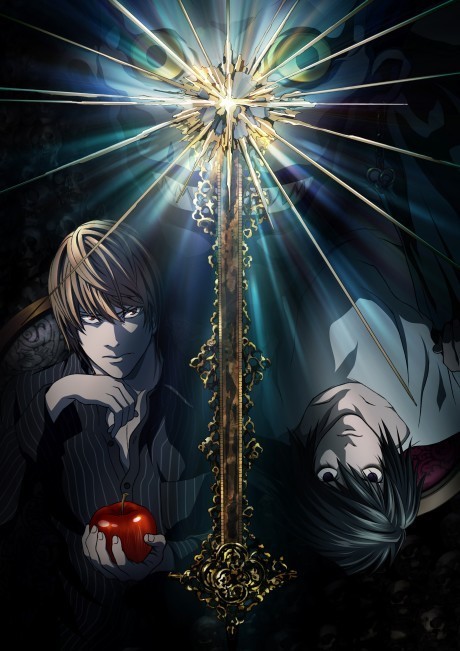
A bored honor student finds a notebook that kills. That single sentence has launched a thousand debates about justice, power, and how fast a good idea curdles into something monstrous — and Death Note Season 1 Episode 1, “Rebirth,” is where the curdling starts. Stay for the first kill. Stay for Ryuk’s introduction. Stay if you want the honest answer to whether Death Note still holds up as one of anime’s great premieres nearly two decades later.
Hook
Light Yagami is not unhappy in any obvious way. He is the top student at his school, respected by teachers, unremarkable in the ways that matter to most teenagers — and quietly, thoroughly bored by a world he considers rotten beyond repair. “Rebirth” does not give him a tragedy to react to. It gives him an opportunity, in the shape of a black notebook that falls out of the sky for no reason he will ever fully understand, and lets his own convictions do the rest.
That is the detail that makes Death Note’s premiere so unsettling on rewatch: nothing forces Light’s hand. Nobody wrongs him. He tests the Death Note out of intellectual curiosity, confirms it works, and then makes a decision entirely his own — to use unlimited, untraceable killing power to remake the world according to his personal definition of justice. The episode is a character study disguised as a supernatural thriller, and it never once needs to raise its voice to be terrifying.
The question this page answers: does “Rebirth” still work as a premiere in an era saturated with “ordinary person gets god-tier power” anime, or does its slow, procedural setup feel dated next to flashier modern hooks? The answer is that Death Note earns every minute of its patience, and this review explains exactly how.
Quick Information
- Anime: Death Note (Desu Nōto)
- Season / Episode: Season 1, Episode 1
- Japanese episode title: 新生 (“Rebirth”)
- Runtime: about 23 minutes
- Studio: Madhouse
- Genres: Psychological Thriller, Supernatural, Mystery, Drama
- Original air date: October 4, 2006
- Kagex score: 9.2 / 10
- Where to watch legally: Crunchyroll, Netflix, Hulu (availability can vary by region)

Should You Watch It?
If you want a slow-building, dialogue-driven psychological thriller that trusts its audience to sit with discomfort instead of resolving it quickly, yes — “Rebirth” is one of anime’s most efficient, confident pilot episodes. It introduces its premise, its protagonist’s worldview, and its central supernatural rule set without a single wasted scene.
Is it worth watching? Yes, unreservedly. Death Note’s reputation as a genre landmark is built almost entirely on the strength of exactly this kind of writing — patient, procedural, and quietly horrifying because of what it implies rather than what it shows.
Is it slow? By modern pacing standards, somewhat — there is no action in the conventional sense, and the episode is built around two controlled kills and a lot of internal narration. That slowness is deliberate. Every beat is establishing rules and character that the rest of the series will spend thirty-six more episodes exploiting.
Is it beginner friendly? Extremely. This is the cleanest possible entry point: no prior knowledge needed, no continuity to track yet, just one student, one notebook, and one shinigami.
Who will enjoy it? Viewers who like morally complicated protagonists, cat-and-mouse plotting, and stories that ask uncomfortable questions about justice without answering them neatly. Who might bounce: anyone expecting fast action or a conventionally heroic lead — Light is compelling specifically because he is not likable in any simple way.
Bottom line: watch it. Few pilots in anime history do more with less noise.
Spoiler Warning
Spoilers for Season 1 Episode 1 follow. Stop above if you want a clean first watch. No Episode 2+ plot beyond what this episode itself sets up.
Story Recap
Ordinary Life (a brilliant student, bored by everything)
Light Yagami sits through high school classes he has clearly outgrown, watching classmates gossip and play games while the television in the background reports one crime after another. The episode establishes his mindset with minimal dialogue: he is intelligent, disengaged, and privately disgusted by how casually the world tolerates cruelty and stupidity. Nothing about his home life or social standing suggests a villain in the making — which is exactly the point.
Across the dimensional divide, a shinigami named Ryuk lounges in the Shinigami Realm, visibly unimpressed by his own eternal, monotonous existence while other death gods gamble away the time. His boredom mirrors Light’s in a way the episode never states outright but clearly intends: two beings, on opposite sides of death, equally starved for something to actually matter.
Unexpected Incident (a notebook falls to Earth)
On the school grounds, Light notices a plain black notebook lying on the ground — the Death Note, dropped into the human world by a Ryuk bored enough to see what would happen. Its cover instructions are absurd on their face: write a name while picturing the person’s face, and that person dies. Light reads it, assumes it is either a hoax or a sick prank, and pockets it anyway, more out of idle curiosity than any real belief in its power.
That idle curiosity does not last long. Once home, Light decides to test the notebook properly rather than dismiss it outright — a small decision that the rest of the episode treats as the actual turning point of his life, more significant than anything supernatural that follows it.
New World (the first kill, and proof it works)
Light chooses his first test subject from a news broadcast: Kurou Otoharada, a criminal holding hostages at a kindergarten after a violent standoff with police. Light writes his name, watches the clock, and forty seconds later, Otoharada collapses dead of a sudden heart attack as the hostages are freed unharmed. Light is stunned, half-convinced it is coincidence, and immediately sick with the implications if it is not.
Unwilling to accept a fluke as an explanation, he sets up a second, more controlled test that same night. Wandering the streets, he encounters a biker, Takuo Shibuimaru, harassing a woman. Light writes several spelling variations of the name to guarantee accuracy and specifies the cause of death this time — a traffic accident, rather than the notebook’s default heart attack. Shibuimaru is struck and killed by a truck moments later. There is no more room for doubt, and no more room for Light to pretend this is an experiment rather than a decision.
First Discovery (the weight of two deaths)
The immediate aftermath is physical: Light is nauseated, shaken, forced to reckon with what he has actually done rather than what he theorized about doing. The episode does not let the power feel clean or triumphant in this moment — killing, even of people the story frames as genuinely dangerous, registers on Light’s body before it registers as ideology. That reaction is brief but important; it is the last time in the series Light will look quite this human about it.
Back in his room, surrounded by a notebook now filled with names, Light gets his first direct encounter with the consequences of what he has claimed: Ryuk appears, and only Light — the notebook’s new owner — can see or hear him.
Important Encounter (Ryuk’s terms, Light’s decision)
Ryuk’s introduction is calm, faintly amused, and immediately unsettling — a towering, grinning shinigami treating mass death with the casual interest of someone finally getting a good show after millennia of tedium. He confirms the notebook’s rules, expresses mild surprise at how quickly and thoroughly Light has already used it, and delivers the episode’s coldest line: when Light’s own time to die eventually comes, Ryuk will be the one to write his name.
Rather than being frightened into caution, Light uses the conversation to finalize his own worldview. He tells Ryuk, plainly, that he intends to use the Death Note to rid the world of evil and rule as the god of the new, peaceful world that results. Ryuk, delighted rather than alarmed, settles in to watch — less a mentor or a warning than an audience member who has just found the best entertainment of his very long life.
Story Analysis
“Rebirth” works because it treats its premise as a character test rather than a power fantasy. The notebook itself is simple; everything interesting about the episode comes from watching exactly how quickly and confidently Light escalates from skepticism to two calculated murders to a stated plan for global domination — all within a single night.
Pacing is unhurried by design. Long stretches of internal monologue and quiet observation let the episode dwell on Light’s decision-making process rather than rushing to the next kill. That patience is the entire point: Death Note is fundamentally interested in how ordinary-seeming intelligence turns into extraordinary danger, and it needs the slow burn to sell that transformation as plausible rather than sudden.
Tone stays controlled and clinical even at its most disturbing. There is no swelling music cue framing Otoharada’s death as triumphant, and no visual sensationalism around Shibuimaru’s accident. The restraint is what makes both kills land as genuinely uncomfortable rather than as action-movie spectacle.
Theme is stated almost bluntly by the end of the episode, and that is a deliberate choice rather than a weakness. Light’s god complex is not hidden as a twist to be revealed later — the show wants you to see exactly how someone this intelligent and this convinced of his own righteousness talks himself into unlimited killing within hours of getting the tool to do it. The horror is not mystery. It is watching the logic assemble itself in real time.
Structure mirrors detective fiction more than typical shonen action, setting up Death Note’s actual genre identity from the first episode: this is a story about method, proof, and escalating cleverness, not about power levels.
Character Analysis
Light Yagami — brilliant, bored, and already convinced
Light’s defining trait in “Rebirth” is not cruelty. It is certainty. He does not agonize for long over whether killing is justified; he tests, confirms, and commits, treating moral upheaval with the same procedural confidence he presumably brings to exams. That composure is what makes him frightening rather than simply villainous — he genuinely believes he is doing the correct thing, and the episode never gives you an easy way to fully dismiss his logic even as it shows you where that logic leads.
Ryuk — bored god, delighted spectator
Ryuk is introduced with almost no exposition about shinigami society beyond a glimpse of bored, gambling death gods passing eternity with nothing to do. His attraction to Light is explicitly about entertainment — a being who has apparently seen everything finding a human willing to do something genuinely new with the tool he dropped. His warning about eventually writing Light’s name is delivered with the same mild amusement as everything else he says, which makes it land as inevitability rather than threat.
The world, briefly glimpsed
Otoharada and Shibuimaru exist in the episode only long enough to be judged and executed, which is intentional — the story is not interested in them as people so much as in what Light’s choice of victims reveals about his self-image. He picks a violent hostage-taker and a street harasser: crimes visible enough on the news to justify his logic to himself, without yet testing whether his definition of “evil” can survive contact with something more ambiguous.

World Building
“Rebirth” establishes its supernatural rules with unusual clarity for a first episode. First, the Death Note kills by name and face — the user must know both, which immediately limits and shapes how the power can be used. Second, cause of death is controllable, with a default forty-second heart attack if unspecified, as shown across both of Light’s tests. Third, only the notebook’s current owner can perceive its shinigami, a rule that isolates Light socially in a way the episode makes visually literal — Ryuk is enormous and impossible to miss, and yet completely invisible to everyone else in every scene.
The Shinigami Realm gets only a brief glimpse, but that glimpse does real work: bored gods gambling away eternity reframes Ryuk’s decision to drop his notebook into the human world as almost recreational, which in turn reframes the entire plot as something that began, from the shinigami’s side, as barely more than idle mischief.
Animation Review
Madhouse’s direction under Tetsurō Araki favors restraint over spectacle, and “Rebirth” is stronger for it. Facial acting carries enormous weight — Light’s controlled expressions during the first test, the flicker of nausea after the second, Ryuk’s permanent, unreadable grin — because the story is fundamentally about internal decision-making rather than physical action. The visual palette leans desaturated and shadow-heavy, giving even ordinary classroom scenes a low, watchful tension well before anything supernatural appears.
Ryuk’s design is the episode’s biggest visual swing: gangly, monstrous, and deliberately unsettling next to Light’s controlled ordinariness. The show commits to making him look genuinely alien rather than friendly-cartoonish, which keeps the character funny and frightening in the same breath — exactly the tonal balance the writing needs from him.
Music and Voice Acting
“the WORLD” by Nightmare opens the series with an aggressive, anxious energy that immediately signals this is not a comfortable story, while “Alumina,” also by Nightmare, closes the episode on a colder, more melancholic note. Yoshihisa Hirano and Hideki Taniuchi’s score underneath the episode itself stays sparse and tense, letting silence do as much work as any cue during both kill sequences.
Mamoru Miyano’s performance as Light is the episode’s anchor — measured, articulate, and just expressive enough at the edges to hint at the conviction underneath the calm. Nakamura Shidō II gives Ryuk a theatrical, gravelly amusement that never tips into cartoon villainy, which is exactly the register the character needs to feel dangerous rather than merely comic.
Hidden Details
Light’s choice to spell Shibuimaru’s name multiple ways before committing to a cause of death is a small procedural detail that plants a much larger rule the show will return to later: precision with the Death Note is not optional, and Light already understands that intuitively before anyone has to explain it to him. Watch how carefully the episode frames this as intelligence rather than luck.
Ryuk’s line about eventually writing Light’s own name is easy to miss as just flavor dialogue on a first watch. It is not. It is the series quietly establishing, in its very first episode, that everything Light builds afterward exists on borrowed time he has already been told about and chosen to ignore.
Also notice the framing device around the television broadcasts throughout the episode — crime after crime reported with no resolution in sight. The show is building Light’s justification for its audience in the background, letting you understand exactly what he means when he calls the world rotten, without ever directly endorsing his conclusion that killing is the answer.
Best Moments
The forty-second wait. The episode’s tensest stretch is just a clock and a boy holding his breath.
The second test. Multiple spelled-out names turn superstition into a controlled experiment — Light thinking like a scientist about murder.
Light getting sick afterward. The last flicker of ordinary human reaction before conviction fully takes over.
Ryuk’s introduction. Calm menace delivered with a grin, redefining the episode’s tone in seconds.
“I will become the god of the new world.” The line the entire series is built to interrogate.
Pros and Cons
Pros: exceptionally confident, patient pacing; a genuinely unsettling character study disguised as a supernatural premise; clean, clear rule-setting; a villain protagonist whose logic is uncomfortably easy to follow.
Cons: the deliberate pace and dialogue-heavy structure will feel slow to viewers expecting immediate action; both victims exist only as narrative props, which is intentional but leaves the episode’s morality feeling slightly stacked in Light’s favor for now.
Final Verdict
“Rebirth” remains one of the most confident pilot episodes in anime history because it never once mistakes restraint for weakness. It sets up a supernatural premise, a chilling companion, and a protagonist whose descent is disturbing precisely because nothing forces it — he simply decides. For Kagex Blog, that is a 9.2: a near-perfect first episode for a series about to spend three dozen more chapters proving Light right about his own cleverness and wrong about almost everything else.
- Story: 9.4 / 10
- Characters: 9.2 / 10
- Animation: 8.9 / 10
- Music: 9.1 / 10
- Enjoyment: 9.0 / 10
- Overall: 9.2 / 10
Recommendation: watch it immediately, ideally without spoilers about what comes next. Few premieres set up a cat-and-mouse story this well before a single mouse has even entered the room.
What to Expect Next
“Rebirth” ends with Light fully committed to his plan and Ryuk fully committed to watching it unfold. Without spoiling how, expect the next stretch to widen the scope beyond two isolated test kills — more names, more scrutiny, and the first hints that Light’s activity will not go unnoticed by the people whose job is to notice exactly this kind of pattern. If the forty-second wait got under your skin, Death Note is only getting started.
FAQ
Is Death Note Episode 1 worth watching?
Yes. “Rebirth” is widely regarded as one of anime’s strongest pilot episodes and needs no prior context to work.
Who is Ryuk?
A shinigami who dropped his Death Note into the human world out of boredom and now follows Light as the only person who can see him.
Who does Light kill in Episode 1?
Kurou Otoharada, a hostage-taking criminal, and Takuo Shibuimaru, a man harassing a woman on the street — both used to test the notebook’s rules.
Is Death Note Episode 1 action-heavy?
No. It is dialogue- and internal-monologue-driven; the tension comes from procedure and consequence, not fights.
Do I need to read the manga first?
No. The anime introduces its premise, rules, and characters clearly for newcomers.
Is Death Note appropriate for viewers who dislike graphic violence?
Generally yes — deaths are shown with restraint rather than gore, focused on consequence rather than spectacle.
Where can I watch Death Note legally?
Crunchyroll, Netflix, and Hulu carry the series in various regions; check local availability.
Is Light Yagami the hero of the story?
He is the protagonist, not a straightforward hero — Episode 1 deliberately makes his logic persuasive while showing exactly how dangerous it already is.
Keep exploring
- Death Note — anime hub
- Browse seasons & episodes
- Death Note Season 1 review — coming soon
- Death Note full series review — coming soon
- Episode 2 review — coming soon
Your turn
Did the forty-second wait get to you as much as it got to Light? Do you think his logic makes sense this early, or were you already uneasy about him? What score would you give Episode 1, and are you continuing straight into Episode 2?